Es Pontas

Es Pontas

Wednesday, January 26, 2011

Palma Party

After our bonfire party in Deya, I wasn’t sure I wanted to see Palma’s version of the event.  I liked the small crowd, good music, and free booze.  But our Deya friends told us to go, so we went.
Palma is a decently big city.  The island has about a million total inhabitants, and half in Palma.  We braced ourselves for a crowded evening.  Apparently the party is week long, with something special every night.  We opted to go on the music night (Wednesday).  There are a lot of different squares in the city (or plazas), and each one had a stage at one end.  And not a small stage.  These were big, music-festival worthy setups.  They were loud, crowded, and amazing.  None of the music was that great (we failed in search for funky electronic dance tunes), but everyone was excited and the energy in the streets was high.
America doesn’t really have festivals like this one.  Most downtown streets were closed.  The pavement was covered in charcoal grills and the scent of sausage was all enveloping.  Beer was sold on every corner, and in all the space in between.  Hand over two Euros and you got a huge plastic cup (a liter?) of cold Mahou or Estrella.  We three wandered through the masses and eventually stumbled upon the main plaza.  It’s sort of raised up from the street; we had to go up a bunch of stairs to get there.  Inside, an enormous bonfire raged, and the crowd was dense with kids, parents, teens, and octogenarians.  Everyone was out it seemed.  The most accurate description would be to simply call it madness.  Everyone over twelve had a drink in hand.  Hot meat was being slung from grill to paper plate haphazardly.  To move through the crowd meant shoving and squeezing by happy families grinning and gnawing on sausage.  But it madness in the best possible sense.  Everyone was smiling, cheering, laughing.  At event with that much freedom in the US, I’d have expected to see a half-dozen passed out college kids on every block.  This was the opposite.  I only saw one person a little to drunk: a twenty-something woman peeing in alley.  It was a little disturbing, but one bad apple doesn’t spoil the bunch in this case.
Reilly at the fire (shamelessly stolen from Dan's facebook)

We grew a bit weary of the crowds eventually, and my hunger grew steadily throughout the night.  Finally we decided to move on, to head deeper into the city, to find a doner kebab.  The perfect late night fast food.  I’m drooling just thinking about them.  Unfortunately, no one could seem to tell us where the shop was (even the numerous people we saw eating doners…).  We trudged on gamely, our hunger urging us on.  Dan and I were on a doner mission.  Reilly was a little upset that spent two hours looking for a kebab shop, but oh well.  It was delicious.  Unfortunately, the next morning we realized it was easily the worst kebab any of us had ever eaten.  At least it filled me up.  
A few days later we returned to Palma for lunch, this time with directions to Kebapa.  Here, we got doners to die for, and my faith in kebabs was restored.  Now to find one in Maine…

A Deya Dinner

In many ways, I’ve been struggling to write these blogs.  On one hand, I have too much to say and can’t pick what to write about.  On another, maybe these stories aren’t exciting in the slightest and I’m dragging my few readers through the seemingly endless paces.  Oh well; I’ll just write a little more and see what happens…
Deya, as I’ve mentioned, is a small town.  Walking the streets and sipping coffee (and beer) at the cafés, we see the same people each day.  Early in the trip, when the amazing and life-changing bar Sa Fonda was open, we made friends with many of the townsfolk, and later, at the big bonfire, these friendships were solidified over wine and dancing.  So, nearing the end of the trip, we were invited to dinner at our friend Dora’s house.
Dora has an interesting back story—she spent her early years in Deya, but then moved to Boca Grande, Florida for middle and school.  It’s no surprise that upon graduation she quickly returned to Spain.  I can’t really imagine a change like that.  Deya (quiet, mellow, Spain) to Boca Grande (rich, weird, Florida).  Yikes.  Anyway, Dora was obviously smart enough to realize this, and that’s why she lives in Deya.  She’s an artist and spent lots of time carving wood.  I won’t explain her project in its entirety because, a) I couldn’t totally picture/maybe didn’t get it, and b) I don’t want to spoil it since it will surely be in MOMA soon enough.  So on to dinner.
We showed up a little late (we had just eaten the lamb at Alaro and then driven back), but luckily no one had eaten yet.  There were nine or ten of us there, and sat in the living room and around the table.  We sipped wine and rolled cigarettes.  We smelled the soup in the kitchen and listened to music.  It couldn’t have been more relaxed.  Llewellyn (the DJ and Robert Graves grandson) picked out the songs carefully and expounded on their virtues, all the while dancing quietly to the beats.  Eventually dinner was served: bowls of hearty vegetable soup (made from “literally everything in the fridge”), a delicious salad, and some crusty bread.  As I was still stuffed with lamb, soup and salad was perfect and I gobbled my share of both right down.  
After dinner, the wine flowed and smoke filled the room.  A fire blazed in the hearth.  Deya is a very spiritual, new-age type of place, and the conversation quickly veered towards time-travel, using pyramids to communicate with a higher power, earthly vibrations, and crop circles.  While none of these topics are my forte, I do enjoy looking at pictures of cool crop circles,
and I’m game to listen rational arguments about time machines and visits to Mars.  
Here's one:


Suddenly it was two in the morning, and people drifted towards the door.  Outside, the moon was practically full, and around was a huge halo.  We lay back on the patio to ogle this astronomical oddity and nearly fell asleep under its glow.  
It looked like this, but with a better backdrop:

Finally Llewellyn stirred us to action, and we departed.  Crashing into bed back at the villa, we slept hard and readied ourselves for our final days.

Tuesday, January 25, 2011

Exploring Old Palma

On one of our rest days (not a second of climbing), we headed into historic Palma to see some sights.  The one that dominates the skyline is the cathedral, and next to it, the palace.  Having just taken an art history course, I was interested in checking out these ancient buildings, and Dan and Reilly were excited too.  Dan did some reading in our Lonely Planet guidebook and planned out a little walking tour of old Palma for us.  
We started by parking under the street; Palma has loads of parking, and it’s mostly underground (and a bit expensive).  Parking on the street is a little stressful, so I usually opted for the subterranean garages.  Luckily, with Dan’s guidance (he has a good sense of direction), I parked in a garage that right next to the cathedral, so the second we emerged from the gloom underground, our view was commanded by the huge buildings in front of us.  The surrounding grounds are stunning; lots of fruit trees and fountains, interesting stone statues, and an immense reflecting pool.  Gargoyles were perched high on the walls and the flying buttresses were a marvel in stone.  Here’s a shot from Google…

And one of the inside

The cathedral is basically a museum now, and cost a few Euros to go inside.  We forked over the dough and went exploring.  Inside, I was instantly blown away.  The ceiling is tall—like 150 feet tall.  I’ve never been inside an old building like this one, but after seeing tons of PowerPoint presentations about Gothic architecture, I was glad to see all the amazing features in person.  Aside from the stunning architecture, there were lots of relics and amazing pieces of art inside.  The metalwork particularly caught my eye: candelabras six feet tall with brilliantly shaped cupids and fauns all over it.  The relics were cool too—one of note was a huge piece of bone (half a femur?) of some ancient saint.  
We sat for a few minutes in the simple wooden pews, speculating as to how many people the huge space could seat.  It must have been well over 500, probably closer to 1000 or more.  Then, back in the sunshine, we headed for an older attraction: ancient Arab baths from the 10th century.  They were a short walk away, and we ambled slowly through the narrow streets.  And I mean narrow.  The surrounding were generally three or four stories, and there was only ten or so feet between them.  When a car went by (rarely) we had to stand tightly to one all.  Luckily most traffic was two-wheeled (mopeds rule in Palma).  At the baths, we paid a few more Euros and went in.  I have to say, it was really disappointing.  I was expecting an elaborate complex of buildings surrounding lush courtyards.  There was a courtyard, and it was slightly lush, but the building was a square room, about 12x12 with a domed ceiling.  Tired looking stone pillars held up the ceiling.  It was an interesting room certainly, and clearly very old, but man it was small, and man it was kind of boring.  Oh well.  Lesson learned.
Here are the baths...

We headed back into the streets to wander for a few more hours, and finally ended up at a café near the port for cervezas.  Then back to Deya to rest our tired feet.
Coming up: a Deya dinner party, a little climbing, some snow, the festival in Palma, a delayed flight, and home to NH.  Don’t stray, I should be posting again soon…

Sunday, January 23, 2011

Lamb

Sometimes you have a meal that is so simple, so basic, yet life-changing.  For a long time I’ve loved lamb.  My dad does it on the grill occasionally, with garlic cloves and onions to add flavor.  It’s a meal to be desired.  I know I’m sounding a little silly, especially because this was supposed to a travel/climbing/adventure blog, but sometimes the trip shapes itself as it progresses.  And not to say that climbing wasn’t central.  We might not have done as many routes as Dan wanted, but Reilly and I were content, and though I’m terrible at remembering specific lines, many that we climbed will be remembered forever.  But back to the lamb.
We headed to a place called Alaro.  It’s relatively central on the island, just a touch west of the middle.  As the crow flies, it’s not far from Deya, but as it usually goes in Mallorca, we had to wind over mountain roads to get there. The final approach to the restaurant was up the standard, steeply switchbacked road that we have found ourselves frequenting.  The restaurant is a ways up, about halfway to some old ruins called Castell d’Alaro (an old castle). We weren’t there to see the castle.  Our friend Mike (the Brit I climbed with earlier) told us about this restaurant, firstly because of the lamb, secondly because it’s where you park for some amazing climbing.  From the dirt parking lot, where sheep are constantly running about (closely followed by young, cute lambs, a fact that brewed some guilt), it’s a thirty-minute walk to the cliffs, down, then back up, crossing a small valley on the way.  Honestly, I wasn’t entirely motivated this day, and didn’t climb much.  The cliff was truly inspiring, tall, tufa covered (like stalactites but not free hanging), and fog enveloped.  The day was cool, damp, and we were tired.  Dan was pumped though and did some great climbing.  He tried one classic route, Buf!, but it proved a little too tricky—he only made it halfway.  Oh well.  He headed down just before dark, and Dan ran ahead to save us a table (we had been told that they close at seven…or six).
Inside, it’s like a cottage out the middle ages.  I don’t know how to accurately describe it.  Picture three long tables, with two more up a few steps.  Now in the back, two big hearths.  A small bar, manned by tough looking, middle-aged women (and older).  On the wall, ancient leather harnesses for some sort of farm animal (burro?).  And directly above me, a mounted, cobwebbed goat head, complete with long horns and a shaggy beard.  The menu only had a few options: suckling pig, shoulder of lamb, lamb chops, and some sort of entrée that probably no one had ever ordered.  When asked for our orders, I go first and say shoulder of lamb.  The waitress simply says “tres?” but its not really a question.  Dan and Reilly nod consent and she goes without another word and returns 5 minutes later with plates heaped high.  A shoulder of lamb, simple green salad, and fried potatoes.  The lamb requires no knife—I could’ve eaten it with a dull spoon.  I wanted to ask how long it had been cooked, but I was too intimated by the Amazonian wait-staff.  Never have I eaten meat so tender, so flavorful, so purely delicious.  It fell from the bones completely cleanly, not a speck was wasted.  We had a bottle of the house tinto (red wine) with it.  It came in a label-less green bottle with the cork shoved in.  In my mind, it came from a huge wooden cask somewhere in the stone-walled basement.  When we finished, the long road to Deya awaited and I sleepily steered us home, completely content with the path our trip had taken.  Don’t worry though, there’s more climbing.
Here's a picture (from google) of a lamb shoulder.  It was way better than this picture.


and here's the cliff at Alaro

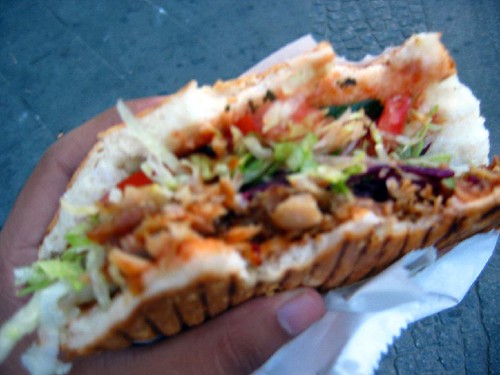
And on another note, we also ate some doner kebabs, which were delicious (and often include lamb too, but in a very different form)
and look like this, but tastier

Oh, and this is being posted from JFK, where I wait for a flight to Portland and then (hopefully) a ride home from my mom.  Yay for madres.  My own bed in a few hours...and lots more blogs in the next few days

Friday, January 21, 2011

Una Fiesta Buena

What? Two blogs in 14 hours?  Holy moly, he's on a roll...
January is an interesting month in Mallorca.  The weather is generally chilly (especially for native Mallorquins that aren’t used to New England winters), and it is certainly the emptiest time of year tourist-wise.  As we found out the hard way, many restaurants and cafés take vacations this time of year and our activities in Deya have been limited at night.  Our first nights just caught the tail end of the New Year’s crowd; we were lucky enough to have some bars and eateries open that first week.  Since then, we’ve been relegated to cooking beans or heading to a bigger city for food.  This lull, though, is fractured by a series of parties that happen annually in each town on the island.  These parties are the biggest nights of the year.  Explanations of their basis were rough, but from what I gather, each town is celebrating their own patron saint.  In Deya, I think this is San Sebastien (as I said before, no one could totally agree.  Too much wine maybe?).  In other cities, the saint differs, but the party is largely the same.
Here in Deya, on Sunday night (this is a very delayed posting), what seemed to be the entire population turned out for the festivities.  There are lots of traditions, and we were welcomed to join by the friends we’ve made in town. In the center of the party is a huge fire made from giant stumps that looked olivine (of the olive tree, possibly a made up word).  Around this the crowd stood, and interspersed in the masses were several huge grills.  These were fed by a guy with a special shovel.  The handle was about fifteen feet long, and with it, the grill-keeper got smoldering coals from the bonfire and carried them through the dense crowd to deposit them into the grills.  On the grates sizzled sausages.  
These sausages were made from the donations of all the local farmers.  One was orange and almost sweet; the other dark and rich.  The food set-up worked like this: long tables held the ingredients—bread, olive oil, tomatoes, and the meat.  Each person grabbed a plate and a slice of bread.  Then we slathered on olive oil and rubbed a juicy tomato onto the bread.  We carried this and our sausages to a grill where we toasted the bread and the cooked the sausage just long enough.  We were so eager to eat that they were still cool in the middle, but local pork is safe right?  We pulled off the bread and meat and gobbled it down.  Dan and I agreed—easily the best sausage we’ve ever eaten.  Reilly isn’t much of a sausage man, but he liked them fine too.  All the food and drink was paid for by the town, so we ate our fill and sat back to digest and enjoy the free wine.
From here, the party took a turn as the DJ changed from a gray-haired guy to Llewlyn, the grandson of Robert Graves (a famous poet and Deya resident).  The dancing started in earnest and the wine and beer flowed almost too freely (almost).  The numbers dwindled as the night got later, but the younger folks like us stayed late, dancing between the fire and the huge speakers, the stars beaming down on us and we beaming up into the night.

Departure in less than 24 hours now.  And guess what...it got cold here, there's snow in the mountains (a dusting), and I'm ready to come home.  Lots more to write about though, keep your web-browsing eyes open.
Adios.

Thursday, January 20, 2011

Es Pontas

Sunday was hot on the East coast.  It dawned cloudy and cool here in Deya, but as I drove east, the skies cleared, and it was bluebird when we got to the water in Santanyi.  Before climbing, we found a café that was quite German. We filled up on our normal lunchtime indulgences (bocadillos etc.), and then headed to the cala (cove).  This was our first time climbing over the water.
Probably the most famous DWS route in the world, Es Pontas, ascends the underside of a dramatic arch.  This arch is a short swim from the rocky shoreline, but the water is decently cold at this time of year (think Maine in early July).  We were all psyched to finally swim though, even if we were a little reluctant to get in more than knee deep.  I finally took the plunge, emerging short of breath but ecstatic.  It’s the temperature that is cold but feels perfectly amazing at the same time.  Dan and Reilly soon follow, and we all climb onto the ledge at the base of the left pillar of the arch.  It’s a big platform, about four feet over the sea, and there’s plenty of room for us three to recline and warm up.  The water is clear and blue.  We put on our rock shoes (which I brought out to the ledge in a drybag) and try our luck scrambling around the base.  It’s pretty steep and sharp, and I’m not much for jumping from height (even though I spoke earlier of my great desire to DWS).  I hop onto a small ledge about fifteen feet high, and after some hesitation, jump off.  Not very high, I know.  Oh well.  
I get used to the water and swim for a while; going between the two legs of the arch while Dan and Reilly stay warm in the sun.  Dan eventually jumps back in and finds a way to scramble all the way to the top of the arch, which is about 60 or 70 above the water.  The formation is huge, so it’s very safe to stand on top, but I was still a littler unnerved when I followed him up to his perch.  Reilly chose to swim back to shore and take some video of us scrambling about, so maybe someday that will surface.  For now, here’s a picture that Dan took from the little overlook.  Picture us standing on the very top.  We would look sort of small.

As the day got cooler, we opted to move back to shore and get some tapas (of course).  Near the café we look for some boulders along the coast.  We find them, but the routes look hard, and we’re tired and damp and the sun was setting.  Finally, we set out for the long drive back to Deya.  In town, there’s a bonfire roaring in the parking lot near our villa.  It’s a town festival, celebrating some sort of patron saint (no locals could seem to agree what saint).  It was maybe, possibly, the most fun party I’ve ever attended.  But more on that tomorrow.  
Sorry for the slowness in blogging, the wifi has been pretty unreliable…Now I'm off to yet another town wide party with a bonfire and an immense jug of wine.

Friday, January 14, 2011

Sa Gubia-A big climb...

Sort of longish post today…and only one picture.  Hope you don’t get bored!
Yesterday (Thursday) was the day.  We got geared up for Psicobloc: bathing suits, lots of chalks, spare climbing shoes, and a long, knotted rope to help us get out of the water (the cliffs are severely undercut in places).  We got up early-ish and headed south.  After 15 minutes in the car, we realized we forgot the guidebook.  The roads are too twisty to turn back…change of plans.  
We pull over in Valledemosa (our favorite town besides Deya, and only twenty minutes south) and get café con leche.  After much laziness-driven discussion, we decide to head back to the port, just a few minutes away.  The cliffs are roadside (I wrote about them earlier) and the approach is literally as easy as stepping from the driver seat onto the cliff.  There are a bunch of great climbs here, most of which we had yet to try since it was busy the other day.
We’re successful on most counts as the day progresses.  The climbs here are thin in places: tiny holds and minimal foot placements.  As the day grows hot, the rubber on our shoes grows mushy and our fingers start to hurt. Dan and I try the first ten feet of a climb about ten times each, but it’s too hard.  Ugh.  Dan then goes for a super steep line that arcs over the road and gets shut down.  He’s able to pull through the hard parts with a little help (yanking on the gear in the rock), then mounts the final section and lowers off.  I make sure no trucks are coming by before I lower too far, or else he would be right in their path (picture him dangling twelve feet high, exactly in the middle of a one lane road as a big dump truck goes: fly-on-windshield situation…).
While at the cliff, a friendly Brit named Mike came by.  He was climbing alone and set up a rope on a bunch of climbs that he mostly powered right through.  I’ve found that old guys tend to have surprisingly strong fingers and predictably good technique.  He was quite a chatterbox, always filling the quiet air with stories of good climbs on the island.  He’s been coming to Mallorca for ten years or so and knows lots about the climbs here.  His favorite topic was Sa Gubia; a cliff we visited several days ago.  He was psyched to climb a multi-pitch line (a classic of the island) and needed a partner.  I quickly signed on and we planned to meet the next morning near the base of the climb.
11:00 am, Friday.  The sun is just hitting the first pitch of our climb.  It seems to have a variety of names, and there are a lot of variations, so for simplicity’s sake, I’ll go with the most simple: Gubia Classic.  It’s a stunning arête, about 1000 feet vertical, then another 800 feet of steep ridge scrambling.  Mike was pretty “keen” on it and had the line all scoped out.  I followed the first pitch, which was harder and steeper than I had hoped, but it went fine.  I led the next pitch, sweating the whole way (from nerves and the sun).  At this point, the upper pitches had been baking in the sun for hours and I could feel the heat radiating off the rock.  We finally pulled onto a sizeable ledge where a couple of boisterous Spaniards were laughing and drinking Coke.  They pointed to the next pitches and then rappelled back the base, now a couple hundred feet down.  I traversed right and up a slab, found a belay after 20 meters, then Mike followed.  He led the next pitch, a rope stretching 60 meters.  At this point, we were nearing the top and I was getting dizzy with the heat and lack of water.  I led a very short pitch to a better belay (a decent sized ledge), then Mike went on through and led the final 80 feet to the top.  From there, we unroped, put on our sneakers, and started the scramble.  At first, the ridge was narrow, about three feet at times.  Big, jumbled blocks led all the way to the true summit, and we went across most of them on all fours.  Eventually, the ridge widened (but also steepened).  I found myself pulling some tricky moves, unroped, with a short tumble and then 1000 feet of air below me.  It was tense, but wonderful at the same time.  It was the most exposed I’ve ever been, and while it felt scary at moments, I loved it thoroughly.
Here's a shot of the steep part.  The scramble begins at the point and heads sort of straight back towards the distant summit.  From the base, that point is around 1000 feet. (The internet has been iffy here, I hope this shot loads)

I didn’t have a camera on the route, but Mike did, and maybe someday he’ll e-mail me the summit pictures.  We signed the little notebook tucked into a copper casing and headed on down the sheep trail.  An hour later, we got back to our cars.  Dan and Reilly were waiting—they had spent the day doing other climbs down below, then Dan got a little bit sick and they sat at the car waiting for awhile.  We all enjoyed some Mallorcan pizza and beer at the nearby café, then headed home to Deya to relax.
We’ve got about a week left, some great climbing and equally great exploring left to do.  I finally checked out the little cove in Deya this evening (it’s a pretty long walk), and it’s simply gorgeous.  Clear water, and a little house (restaurant?) perched above the calm sea.  It felt a little cold for swimming, but maybe I’ll get tempted soon.

Thursday, January 13, 2011

More Catch-Up

Back to what’s important: Food.

Listing each meal would be very time consuming (and probably a little boring), as we have eaten out most every meal.  But with the groceries so expensive and the tapas so cheap, why not?  Bocadillos have become my favorite food here.  They’re basically little sandwiches on baguettes with various meets and cheeses.  I had one for lunch yesterday that was a revelation in tuna.  Luckily, practically every restaurant serves these, and they cost little.  I can’t say we have established a routine in our eating habits, but very loosely each day goes like this:  breakfast of café con leche and an orange, lunch of tapas and una cerveza, tapas in the late afternoon (a post climbing snack), and then dinner around 9.  Tonight (it’s 11pm on Wednesday as I write this) we broke from traditional Spanish foods and found some doner kebabs in Palma for dinner after a long day of climbing on the far northeast coast (look for Pollenca on the map below, we were way out on the upper peninsula).  There have many, many more memorable meals.  Maybe I’ll get to them once I digest.  One more highlight: stewed rabbit with onions and a big glass of Estrella.  See silly picture below:


Climbing:

This is an easy catchup.  Yesterday, we took a rest day.  I packed up my suit and towel before our sightseeing drive to Port de Soller hoping to maybe squeeze a climb in on a cave over the sea, but we got a little lost on a scary dirt road…(see driving section).  Today, we headed way northeast to an amazing cliff on the coast.  To get there, we drove for a few kilometers up switchbacks then parked at a viewpoint where tourists were swarming.  Reilly, Dan, and I checked out the view too.  It’s a huge cliff, plunging about 700 feet to the sea.  There is a viewing walkway perched on top and the view was unreal—pounding surf far below, sheer cliffs in all directions.  The amount of rock on Mallorca is astounding.  There are cliffs everywhere.  I can’t stress that enough.  Everywhere.  Driving along, a new, amazing wall comes into view around every corner. 

From the parking lot, we headed through some tall grass for about ten minutes, then wound our way up a trail marked with cairns that took us through a break in the hillside and down into a quiet valley.  Here, we found our climbs for the day.  The sun got brutally hot soon after we arrived, and we were all shirtless, basking in its warmth.  We knocked off a couple climbs that were my favorite thus far.  Very balancy, very small holds, and unique, awesome movements.  As we finished, a hiker wandered through our quiet valley and called out to us.  “Habla español?”  “Inglés!” we shouted back.  We commenced in English: him yelling about being lost, and us yelling directions.  He opted to wade across the tall grass and follow us back to the parking lot. 
Our new amigo, Antonio, was out for a short hike, scoping out the landing for BASE jumping from the lookout.  He was very friendly and when we got back to the parking lot, we followed him to town and enjoyed a beer down by the water while he rambled about his skydiving passion.  Here we are on the trail back to the cars:


Driving:

This is has come up in most of my other writings, but I just want to say that driving in Mallorca is ridiculous.  That’s the best way to describe it.  In the city, it’s fast and cutthroat.  In the mountains, the switchbacks are endless and the roads sometimes wide enough for only one car.  The scariest instance so far was looking for some cliffs near Port de Soller.  We headed up a dirt track that could have been built for horses.  The switchbacks were so tight that I had make a two-point turn around each one, and as I did, I engaged the E-brake for fear of plummeting off the sheer drops down into the sea.  It’s hard to describe really, but just know that it was scary, the car got a little beat up, and I know drive with more confidence on the seemingly wide roads near our villa (which are actually also quite narrow and have no shoulder at all).


Soon I’ll write about Sa Fonda, the most popular (and only open) bar in Deya.  We’ve made lots of friends there and have been quite sad at its recent closure.  I pray it opens again tonight…

Here are a few pictures (again from Reilly)…

Cafe on the port

Our table for dinner one night


We took lots of climbing pictures recently, but Reilly forgot the cord for his nice camera (these are all from an iPhone).  Oh well. I'll put some up when I return I suppose

Adios!

Tuesday, January 11, 2011

Day What?

Time is flying by here in Deya.  It’s Tuesday; one week ago I was waking up to bagels in New York about to head to JFK.  A lot has happened in a week.   Everything mostly falls into a four categories (food, climbing, driving/walking, and Sa Fonda), which I’ll try and cover in the next few posts.  It might take a few to catch up...
Food: 
I’ve been slacking in taking careful notes of our daily activities, so after a week I’m finding it difficult to remember exactly where and when we have been eating.  Some meals, though, are hard to forget.  Our first night, refreshed from a 3-hour, jet-lag nap, we walked into town, just a few minutes stroll uphill.  Deya is quiet this time of year, and a few of the local cafes were already closed for their winter holiday—the fancy hotel across the street closes for the entire month of January.  Most restaurants that remained open were quite expensive, and we were hungry for tapas, so up the stairs we went to Café Sa Fonda.  Their sign promised tapas, ensaladas, and bocadillos.  At the bar, we stumbled through basic Spanish phrases asking for a table and menu.  In English, the gray-haired bartender said “No food.”  “Tres cervevas,” we responed (this was to become our mantra), and took our ice cold beers outside onto the patio.  A while later (see the Sa Fonda section below), we headed back down to the street, famished.  The only restaurant open was the priciest of all, but our judgment now clouded, we sat down and ordered wine and suckling pig and the local fish.  I know have a new understanding and appreciation for pork.


Climbing:

At first, we lacked a guidebook, and ventured into the unknown with enthusiasm.  Reilly had spotted a cliff during his taxi ride, so drove south on the second day and found a beautiful limestone crag spitting distance from the road.  It was mid-afternoon by the time we arrived, but we climbed until dark and got up a handful of inspiring routes.  Luckily, even in our ignorance, we chose mostly moderate routes and were able to complete them all.  The rock on Mallorca is largely limestone—a type of rock that lends itself to beautiful, unique, perfect, (I could go on) climbing routes.  The holds are varied and unlike any other stone I’ve climbed.  Deep pockets, tiny crimps, tufas (like stalactites) that snake down the wall.  The colors are astounding—blacks and grays, of course, but vibrant oranges and reds too.  And in the background, the blue of the Mediterranean.  
The second day, we head for another roadside cliff.  I printed a basic guide to it from a climbing website, so we have some idea of what grades are ahead.  When we arrive, we realize we’ve forgotten the rope.  We head into Palma, the big city, to buy a proper guidebook.
The next day, we head into the mountains.  Sa Gubia is our destination.  After a walking down a few wrong roads and encountering a few savage looking guard dogs, we find the dirt track, follow it to a dry river, and scramble up the polished stones high into the hills.  The walls here are immense—a thousand feet or more in places.  We stick to some of the lower walls and knock of a handful of inspiring climbs.  Dan tries a steep line and only makes it halfway, but wants to try again another day.  At one point, as stand on a steep rock slab that leads to another cliff, a sheep appears from above and careens by us in the way that only sure-footed sheep can.  We watch in awe as it ably slides down rock that we had climbed tenuously on all fours a moment before.
Each morning, we plan to wake early, but the village is so deep in it’s valley that the sun doesn’t pass the peaks until noon.  After another late start, we head for a cliff with a short approach.  SO short, in fact, that you step directly from pavement onto limestone.  This cliff, perched on a narrow road high above Port de Valledemosa, is the most dramatic of all.  The panoramic view is absolutely stunning—the village thousands of feet below, the peaks soaring above, and the sea stretching towards infinity.  We climb until dark again; the sunset is maybe the best I’ve ever seen.  Deep pinks and reds glowing across the clouds, reflecting off the green hills and blue water, shimmering on the waves.
Yesterday (I think I’m all caught up), we again headed up into the mountains.  Goats ambled through the forest at the base of this cliff.  What we find is, as usual, inspiring.  Our first climb is up a narrow chimney.  Like climbing a doorjamb in grade school, we all wiggle ourselves up this maw of stone and find exultation once on top.  The next is my favorite climb so far—very tall, very scary, and very amazing.  Nearing the top, I find I’m running short on gear, and in my panic-induced tunnel vision I miss the obvious line, scramble up a dirty, brush filled gully, nearly pulling down several loose blocks of stone.  Finally, trembling, I hold with bush with one hand and ease back out onto the face.  One more delicate step and I clip into the anchor—safe.


That’s enough catchup for today.  I’ll write again soon about driving and walking, and more eating, and of course, our favorite café: Sa Fonda.  And soon, we’ll check out some beaches and hopefully climb over the sea…

More to pictures to come soon!

Saturday, January 8, 2011

The Before

I first saw footage of Mallorca years ago, when, in many ways, I was a similar climber to who am I am today.  I was younger and probably much weaker (not that I’m strong now), but I was just as consumed with the idealized notion of climbing.  And for me, the ideal comes in an astounding variety of ways.  This video:


Can be equated to this one:


I am equally interested and driven to accomplish both.  There is something just so elementally raw in climbing, and this rawness can achieved in so many ways—be it wearing a bathing suit and rock shoes high above the Mediterranean, or down jacket and crampons high in the Alps.  These two pursuits are only 900 or so kilometers apart, but yet are so fundamentally connected.  It this connection to the basics that draws me to climbing: taking only what you need to complete the objective ahead and then moving on to the next.  And the various disciplines of climbing lend themselves quite easily to this simplicity.  I have not yet Deep Water Soloed (DWS or ‘Psicobloc’ in the local climbing argot, a type of climbing where one ventures high above the sea without any sort of rope), but am deeply excited about setting out into unknown, vertical terrain high above the sea.  These climbs range from 5 to 30 meters above the churning blue waters and require only courage (but I’ll wear rock shoes and use chalk to boost my confidence).  


Thousands of kilometers away, back in New Hampshire, climbs like this do not exist.  DWS is a specialized sect of climbing, found in large quantity in only a few locales around the world.  I’m sure there are many dramatic cliffs plunging into the sea in Maine and California and maybe other spots stateside, but here in Europe, hundreds of Psicobloc climbs litter the cliffs of this island and others.  However, the boldness of these climbs can easily be echoed elsewhere.  Just before my departure, I went for a quick ice climbing session with Wes, my younger brother, at the cliffs in Rumney, just west of my home in Plymouth, NH.  We chose an unknown route and set out, me in the lead.  I hadn’t climbed on ice in about eight months, but had faith the line was easy enough for me climb without falling, as I own only two ice screws to protect the hundred-foot, ledged curtain (thereby risking 30-50 foot tumbling falls).  Once I made it over the initial vertical bulges and placed my first screw, I felt more secure, but after the next vertical section and the ensuing hollow ice, things began to get touchy.  I gamely scrambled on up the final ledge, trying to forget that if I fell, both ice screws would likely pull out from the rotten ice and I would fall all the way down to Wes, 75 feet below.  The final twenty feet were vertical at the onset, and then eased into a dirt slope up to a big oak tree at the top of the climb.  I tenuously eased up the thin ice guarding the top and pulled onto the snowy, grassy slope.  The last few feet were a relief: I was able to stand almost upright, and almost ran to the tree that marked the end.  Here, I threw a nylon sling around its base, clipped myself in, and proceeded to belay Wes to the top.  He made it up easily with the confidence of a belay from above.  Ice in New Hampshire, limestone in Mallorca.  


Worlds apart, surely.  But these climbs are connected by so many ideals.  Adventure, confidence, and a desire for the true nature of climbing.  If I didn’t get scared, I wouldn’t do it.  But it’s fear, overcoming that fear, and a sense of true, deep accomplishment that drives me and countless others into this seemingly crazy pursuit (among many other factors of course—as Hillary said, “Because it’s there”).  Mallorca and DWS offer this at its most basic level, and this is what brought me here.  Warm weather, tapas, and climbing, climbing at its purest.  And the café con leche in the morning and cerveza in the evening don’t hurt.  Not to mention the siestas. 


Here are a few pictures (all taken by Reilly Taylor) from our first days in Deya (the Catalan spelling as opposed to the Spanish Deia):


The view from a lookout a few kilometers South

Our road

Out exploring

A delicious orange

Friday, January 7, 2011

Travelin' (pictures to come)

It’s approaching the 36-hour mark in Mallorca, which is somewhat equal to the amount of time it took to arrive here.  The trip was smooth overall—buses from Concord, NH to Boston, and Boston to New York City.  A night spent in New York (hamburgers followed by cupcakes in Greenwich Village) followed by an afternoon flight from JFK direct to Barcelona.  With my standby ticket I was bumped into the last empty seat in first class—a luxury I’ve never had before and may never again.  Soup, salad, crabcakes.  Airplane food isn’t so bad after all.  My traveling companion, Dan Austin, was unlucky and was relegated to the coach cabin where he dined on “shitty chicken with cream sauce.”  The flight was uneventful and soon we were in Barcelona airport; it’s a stunning terminal, huge open spaces, glass and marble everywhere, clean and well lit.  We picked up two tickets for the last leg of the journey: a quick 45-minute flight to Palma, the capital of Mallorca.

We picked up our rental car, and since Dan cannot drive a stickshift, I hopped into the driver’s seat and surged ahead onto the streets of Palma with the radio echoing our exclamations of glee with music thumping out the open windows.  The traffic was dense and fast and slightly hazardous.  I’m not sure I saw anyone use a blinker as they sped between lanes without warning.  Never having driven in a place quite so fast paced, I was nervous at first, but soon embraced the quickness of pace and zoomed through the narrow streets freely.  We had no accurate map, so we ended up lost in the city for thirty minutes, but then, back on a main road, we spotted a sign for Soller, a town we knew to be just north of our destination: Deía.

Up and up and up—switchbacks dominate the landscape as we rise into the mountains west of Palma.  We’re heading for a pass several hundred meters above the olive groves lining the road we drove a few minutes before.  There are two options on this road—the col or the tunnel.  Hoping for the view, we choose col and begin to climb.  Bikers speed down the road towards me as I slow at the hairpins and accelerate into the next steep grade.  At the top, I pop into neutral and coast the first steep downhill before needing to hit the brakes and using third gear to slow our momentum.  We roll through Soller and head down to Deía, a small town that will house us for the next eighteen days.  After a few wrong turns, we found our road, Son Canals, and pulled into the parking spot marked for #1C.  Reilly, our other climbing partner, is yawning on the porch—he arrived yesterday and spent the evening lounging and eating ham and cheese.  But now Dan and I have arrived, the trip proper will begin.  We’re giddy with travel fatigue and jet lag, but quickly rally.  Deía is a town that begs to be explored on foot, so we set out to see the sights.  The streets are all stone, los gatos roam free, and everything is closed mid-afternoon for the country-wide siesta.  We find ourselves on a narrow dirt path, traversing a steep hillside, just below some houses and just above others.  In front of us, the Mediterranean is huge, blue, and calming.  An hour later, we’ve wound our way back downtown and sit on a stonewall to enjoy the best orange I’ve ever eaten.  We’ll go climbing tomorrow.